
Consistent Forming with High Precision
Robotic Press Braking
Robotic press braking is used when consistent quality, efficiency, and stable production flows are essential. The method is particularly well suited for serial production, where every bend must be performed consistently from the first component to the last.
Robotic Press Braking Process
Our Approach
Robotic press braking is applied where automation creates a clear advantage in both quality and productivity. The process is programmed according to the component geometry, material type, and bending sequence, ensuring that every operation is carried out precisely and repeatably. Our robotic cells handle components safely throughout the entire process, ensuring stable and predictable results.
What You Get
Automated Workflow
- Consistent bends with high repeat accuracy
- Efficient production for larger series
- Stable processes without manual variation
- Safe handling throughout the bending process
- Flexibility for both simple and complex bends
Technical Description
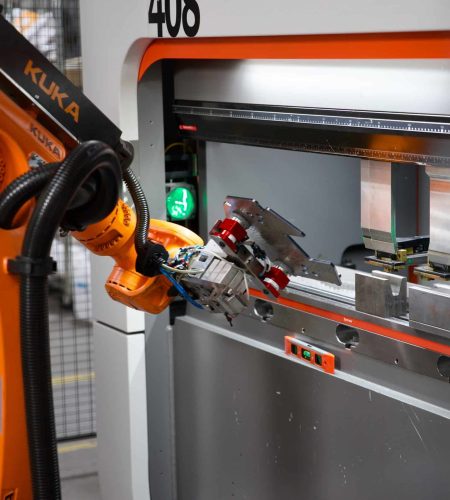
Robotic press braking is performed in automated production cells where the robot and press brake operate in close coordination. The robot controls the position of the component and guides it precisely through each bend, ensuring accuracy and consistency — even in complex bending sequences. Automation reduces manual intervention and minimizes the risk of errors, which is particularly beneficial in serial production and for components where small variations may affect fit or assembly.
High Volume & Process Control
Machinery & Capacity
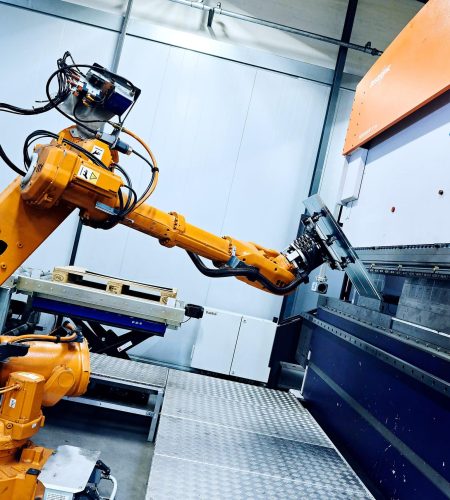
Hosta Industries operates three robotic bending cells:
One Large Cell
- Developed for handling larger components and complex bending sequences
- Ensures stable results for larger formats and heavier materials
Two Smaller Robotic Cells
- Flexible and well suited for serial production of small and medium-sized components
- One cell is equipped with two robots working together to ensure fast, efficient, and stable bending at high production speeds
The largest robotic cell can handle:
- Robot payload: up to 135 kg
- Component width: up to 3100 mm
This makes it possible to bend everything from lightweight sheet metal parts to heavier components.
Results from our customers
Illuminated Silhouettes for Brønderslev Municipality
Mermaid Whistles (Havfruefløjterne), Fredericia Municipality
Our Expertise, Your Savings
Warehouse Solution Integrated with Demand Forecasts
Framework Agreement for Mutual Benefit
Customer-Specific Kit Packaging
From Design to End Customer
Second Source for Turret Punching
Significant Cost Savings Through the Right Manufacturing Technology
One Piece Flow Ensures Fast Delivery
Technology Insights & Flexible Manufacturing Capacity
Flexibility & Fast Delivery
Tube Laser Cutting Capacity During Peak Season
FAQ – Robotic Press Braking
Frequently Asked Questions
If you cannot find the information you are looking for, please do not hesitate to contact us. Our specialists are ready to assist you.
When is robotic press braking the right solution?
Robotic press braking is well suited to serial production where consistency, repeatability and efficient production are required.
What size components can you bend using your press-braking robots?
We can bend components up to 3 metres wide and with a maximum component weight of 135 kg.
Is robotic press braking more accurate than manual bending?
Not necessarily. The press-braking robot works with conventional press brakes, which are also used for manual bending processes.
Let’s Start the Conversation
Start Your Next Project With Us
Contact us today for a quote or technical consultation — we’re ready to elevate your production.